Showing posts with label Master Agency. Show all posts

Monday, August 31, 2015

How to Know What Insurance Customers Want

Great article on important things our Tague Alliance member clients and prospects want from us....


How to Know What Insurance Customers Want

By Andrew G. Simpson | August 25, 2015
customers
What do today’s customers want from insurance providers?
They want understanding, interaction, even a relationship. But they vary in when and how they wish to learn, interact and build a relationship.
A word from our sponsor:
Sponsored by: FC Business Intelligence. Click here for more info.
Insurance IoT USA conference and exhibition
 will take place onDecember 1-2, 2015 at the Ritz-Carlton Coconut Grove, Miami. This is the only event focusing on the challenges and opportunities of IoT for the insurance industry. Join 20+ expert speakers and 150+ insurers and secure your place now.
Insurance providers have to understand not only when but also how to best help customers with their needs, Lynn Kesterson-Townes, worldwide commerce marketing leader for IBM,told the Insurance Marketing and Communications Association (IMCA) Annual Conference in Nashville.
Firms that figure out how to serve millennials will be able to capture other customers more easily and keep them, the e-commerce expert said.
According to Kesterson-Townes and research she shared from IBM, the insurance marketing and communication strategies of the past no longer work because insurance customers have changed.
“Obviously, they’re the same people, but the way they want to interact with their insurers is very different these days,” she said.
One way customers have changed is that they are less loyal than customers used to be.
In the past two years, 37 percent of customers of insurers contracted with IBM report that they switched their insurers. This churn rate is rising, it’s up 13 percent over the last few years.
“That’s because we believe that in today’s customer‑activated environment, marketing and communications strategies that used to work are no longer working to sustain retention or to significantly grow the business,” she said.
What Customers Want: IBM’s Kesterson-Townes at IMCA
Powered by InsuranceJournal.tv
Bob and Ann
Kesterson-Townes shared two examples. One was a man, Bob, who had a car windshield claim. He also had a $50 discount coupon that would have helped pay his deductible.
“Except for reasons that no one can understand, the insurer didn’t let the auto glass place accept the coupon. No one’s actually to this day figured out why not. Bob’s still baffled why his insurer wouldn’t let his coupon be used. The auto glass place didn’t understand it. Bob had to pay the full deductible. Guess what else? The auto glass place didn’t lose a customer, but Bob switched insurers,” she said.
The other story was about Ann, whose husband just died in a fatal car accident. She received a condolence letter from her insurance carrier. Unfortunately, in the same envelope Ann also received a letter from the same insurance company informing her that her coverage was being cancelled.
“Unbelievable, right? Unbelievable. How did the marketing and communications department get to this point? Sorry your husband died and oh yeah, we’re canceling your policy! Did they not want to use another stamp? You wonder what was going through the heads of people, right?” said Kesterson-Townes.
According to the IBM consultant, these insurers were not thinking about their insureds at these critical times of interaction.
“That’s what customers are looking for today. They’re looking for an understanding of their personal situation when they’re having an event, when they’ve actually had a change in their own situation, and they’re looking for people to help them cope with it. They’re looking for that from their retailers, from their airlines, and from their insurers,” she said.
Interaction Points
She said today’s customers also expect all of the people they have relationships with to be able to respond in the same way. “Therefore, marketing and communications functions in insurers need to be more nimble, more innovative, and better able to engage with their customers and help their entire ecosystem along as well,” she said.
“They don’t want channels. They want interaction points, and we’ve changed that language on purpose because channels infer a one‑way communication. From me to you, from the insurer… ‘Let me push this product to you.'”
As examples of interaction points Kesterson-Townes cited emails from brokers, face-to-face-meetings, talking to a customer service representative over the phone, and click-throughs on a website, even a comparison website.
“As digitally enabling technologies empower and connect customers more easily with businesses and with each other, a one‑size‑fits‑all marketing and communications strategy no longer works. In fact it’s competitively disadvantageous because what we used to have is an organization‑centered economy and now we have an individual‑centered economy,” the IBM executive told the communications professionals.
Today’s customers are using a variety of web‑based interactions to talk to insurers, she said. In the beginning information and quoting stages, they are using a variety of interaction points and they don’t necessarily purchase where they’re searching, IBM’s research shows. In fact, it shows an 18 percent shift away from personal interaction and toward digital interaction at the beginning.
Personal Touch
But that doesn’t mean personal interaction is dead.
“[A]t the point of purchase, we are still seeing a lot of interaction, whether it’s on the phone or in person with a broker. What does this mean for insurers? Customers are obtaining their information and they’re quoting digitally. Then they’re purchasing a lot of times physically, we would call it,” she said.
She said this means that insurers need to be proficient at omni-channel marketing, at merging the digital and the physical experience so that for the customer it feels like the relationship is “building all along instead of restarting with every new interaction point.”
Due to the ubiquitous connectivity, insurance customers are looking for these “customer‑centric” interactions.
To meet this expectation, insurers need data. “You need to know where your customer is in the decision process. You need to know what’s going on in their lives to be causing this decision to be made,” she said.
Lead with Millennials
She stressed the value in being a leader rather than follower in understanding customers. The best place to lead is with millennials, the most empowered generation, people who are under the age of 30.
“You need to embrace your digital millennials because you can learn a lot from them. Once you get successful working with them you can use those lessons in other areas,” she advised.
She said two‑thirds of millennials are demanding customer digital and physical experiences that are harmonized.
“They want increased transparency. They want to really interact and have a relationship with you. They want an understanding of their personal needs. They want fast responses. They still want advice. But if their needs are not met, they’re even more likely to switch insurers than the rest of us. But they’re looking for value. Notice, I said ‘value’ not price,” Kesterson-Townes told the audience.
“We believe that if you can market and communicate to millennials effectively, you will actually be able to capture all of your customer segments,” she said.
That’s because, like millennials, all insurance customers today want four things.
“They want advice, simplicity, convenience, and value from their insurers, which brings us to trust. After all, insurance essentially started as a social network among like-minded people to share risk. How come most customers don’t trust their insurers?”
She said IBM surveys show that more than half (56 percent) of customers do not trust their insurer and that people with low trust in their insurers are almost 20 percent more likely to switch their providers. “That’s why this is important to you,” Kesterson-Townes told the IMCA audience.
According to IBM, it’s not useful to simply look at demographics or ages to segment today’s customers. Demographics actually offer limited insight into predicting the interaction point preferences, she said.
“How do you know if this customer would prefer to talk to an agent online, would prefer to see an agent in person, or would prefer to interact via email? Will demographics give you that answer? We would say, ‘No. In fact, they don’t.'”
Sometimes, demographics even appear counter-intuitive. For example, the youngest age bracket, those under 24 years of age, are not the most likely to purchase insurance via the Internet, she said. Nor is it the next oldest age group, those 24 to 34. It’s actually people 34 to 44 that are most likely to purchase insurance over the Internet.
“That’s a little counter-intuitive to some people. Some people would think the younger, the more likely.”
Psychographics
If not demographics, then what should insurance marketers rely on to understand customers? IBM thinks psychographics, or segmentation based on customer attitudes, is the answer.
“It’s based on behaviors. It’s based on their needs,” she said. “That is much more indicative of how someone wants tot be interacted with, not just how old they happen to be. ”
She said IBM has found that psychographic segmentation is four times more likely to point to the right interaction point than pure demographic segmentation analysis.
IBM identifies six customer segments, to which it assigns names including Loyal Quality Seeker and the Price-Oriented Minimalist.
Kesterson-Townes profiled three examples of growing customer segments.
Demanding Support Seeker
Susan, 33, is unmarried, an energy consultant, and moving from Seattle to Boston. So she needs car insurance, and also needs insurance for her new house in Boston. And she wants life insurance because she’s going to be adopting a child in Boston.
From a psychographic standpoint, Susan is a “Demanding Support Seeker” in IBM’s segmentation, or as Kesterson-Townes described her, “she’s high maintenance.”
“She acts like a traditional insurance customer. She needs a lot of hand‑holding. She really looks to insurers for advice. She trusts them, but she’s also every bit a person of this age, so she’s a modern empowered consumer,” she said.
This customer is very connected and social media savvy but prefers that all of her interactions be personal, from information gathering all the way through purchase and servicing after purchase.
“Demanding Support Seekers, or these high maintenance ones, have the lowest technology affinity in interaction. They want advice. They want full coverage. They want a one‑stop shop. They want someone on the other end of the phone,” Kesterson-Townes said.
Support Seeking Skeptics
John and Ann Cooke of Los Angeles epitomize the second segment Kesterson-Townes described. John is a 28‑year‑old manager at a large retail store. Ann is a 25‑year‑old nurse at a local hospital. This couple is extremely active on several social media sites, especially Facebook (which Kesterson-Townes says is actually for older people these days).
John and Ann are discussing buying a new car. They’ve done a lot of research on their own. Now they’ve turned to Facebook to seek advice from their friends and family on their experience with three models they are considering.
John and Ann are “Support Seeking Skeptics,” in IBM’s psychographic parlance. Support Seeking Skeptics have a medium technology affinity, but when it comes to social media, they’re “off the charts.”
They don’t feel well‑informed about insurance. They are young and haven’t had a whole lot of experience with it. They don’t trust insurers. They’re looking for advice about insurance at the same time they’re looking for advice about which car to buy.
How they prefer to interact with insurers depends on where they are in the process, according to Kesterson-Townes. For example, when searching for insurance, they want to hear from their peers about their experiences. They don’t want to interact with insurers. But when it comes to purchasing, they will flip to a personal interaction such as telephone or face‑to‑face.
“If you’re trying to sell this kind of group car insurance, for example, make sure you’re Facebook friends with John and Ann’s friends and network in,” the IBM expert advised.
Informed Optimizer
The third fast-growing segment is represented by Dan, a 27 year- old single and very successful video game designer who’s purchasing his first rental property. Dan is an “Informed Optimizer” in IBM-speak. “These guys optimize everything. They want to have the right insurance from the right insurer at the right time,” Kesterson-Townes said.
These customers have a very high technology affinity, they’re highly self‑sufficient, they’re informed, and they’re willing to experiment.
“They seek an optimal priced‑value ratio. Price is important, but they will shop around for exactly what they want,” she said.
They prefer to interact digitally throughout the process if possible, even through purchase and servicing. “They’re comfortable in that world, but because they want the tailored product they demand, they’ll get on the phone if they have to, to get exactly what they need,” she added.
As he researches landlord policies, Dan would be really impressed if an insurer reached out to him while he’s online with an appropriate product offer. If a company actually includes an app that Dan can use to communicate with the insurer throughout the relationship, Dan would be thrilled.
Merging Digital and Physical
While these three segments differ in their needs and preferences, they are all engaging in omni‑channel behaviors. Kesterson-Townes said IBM research shows that 80 percent of insurance customers are already using two or more interaction points for information gathering and quoting process. Twenty percent are already using four interaction points or more. Consumers say they expect to be using four interaction points or more in the near future as they look at insurance.
“Again, now’s a good time to start thinking about merging those digital and physical spaces,” said Kesterson-Townes.
She stressed that personal interaction will remain important. In fact, the highest sales conversion rate is in transactions through personal contact, with about 80 percent, versus 30 to 40 percent conversion on websites.
Seamless Experience
Customers want a seamless experience, involving  every contact that they have with the insurer, so they don’t have to start over providing their information at every interaction. That turns them off, the IBM executive told IMCA.
“Therefore, when they do talk to, let’s say, your call center rep, marketing is no longer about the call center rep getting out the right script and starting to pitch whatever product is the product of the day,” she said. “It really is about understanding what that customer’s talking to you about and being able to take them to the next level. ”
Marketing is about personalizing the experience for thousands, or even millions, of customers.
“Whether you’re responding to a customer in real time or anticipating a need that they didn’t even know they had, today’s insurance marketing and communications functions must exceed expectations to give their companies a competitive edge. It’s not just about speed. It’s about the experience. Every interaction is a moment of truth and moments matter. It’s about delivering relevant experiences at the right time and the right place,” she said.

Wednesday, May 27, 2015

ISO Releases 2014 P&C Insurance Industry Results

Tague Alliance members enjoyed a great 2014 and that was correlated with a solid industry result last year as well.  Below is the text of an article released by ISO on the industry results.


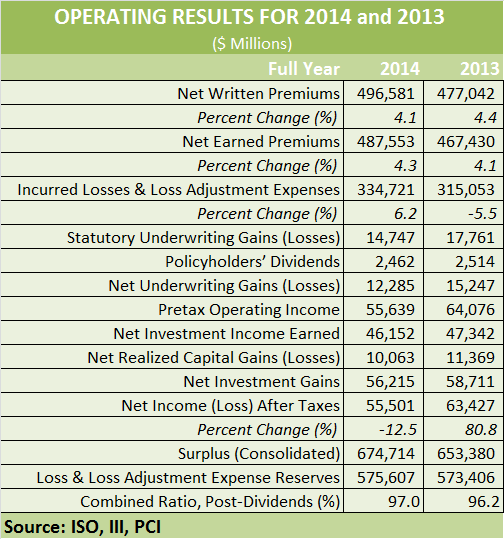
Net income for U.S. property/casualty insurers totaled $55.5 billion after taxes last year, coming as little surprise to experts who had forecast a $50-billion-plus result early this year.
In early January, Robert Hartwig, president of the Insurance Information Institute, gave one of the earliest forecasts of full-year industry income, predicting a figure just over $50 billion, along with a policyholders surplus level of $675 billion and a return on equity of 7.7 percent.
See related article, “Profit Estimated at Over $50B for 2014
The official results published on Tuesday by ISO, a Verisk Analytics business, and the Property Casualty Insurers Association of America, showed Hartwig’s surplus forecast was right on the mark. But with net income coming in $5 billion more than expected, industry ROE was actually 8.4 percent.
2014FULLYEARISOPCI
While the 8.4 percent return may have seemed disappointing when compared to the double-digit return of 10.2 percent for 2013, overall net profit came in at the second highest level since the financial crisis—surpassed only by the $63.8 billion profit number for 2013—Hartwig and Steven Weisbart, I.I.I.’s chief economist noted in a commentary about the ISO/PCI results.
In both years, insurers faced low levels of catastrophes but the catastrophe loss tally for 2013 was just a little bit better (lower) than 2014. Direct insured losses from catastrophes for both 2013 and 2014 fell far below 2011 and 2012 levels—among the costliest on record for catastrophe losses, Hartwig and Weisbart said, noting that in 2013, direct insured losses from catastrophes plummeted $22.1 billion to $12.9 billion.
According to the ISO/PCI report, direct insured property losses from catastrophes hitting the U.S. grew $2.6 billion to $15.5 billion in 2014 but this was still $7.2 billion lower than the 10-year average of $22.7 billion.
“Wildfires, winter storms, hail storms, and tornadoes all took their toll, but there was no single event that did enormous damage” in 2014, Hartwig and Weisbart they wrote in their commentary.
“The industry’s performance in 2014 could be considered a return to long-term trends, neither as strongly profitable as in 2013 nor as catastrophe-impacted as in 2011 and 2012,” they concluded.
In addition to modestly higher catastrophe losses, a lower level of investment income played a role in the driving the profit level for 2014 below 2013’s overall result. Investment income—primarily interest payments from bonds and dividends from stock holdings— dropped 2.5 percent to $46.2 billion.
Losses and Premiums Growing—But Not at the Same Rate
On the underwriting side, another highlight from the ISO/PCI year-end figures was the level of net written premiums, which jumped 4.1 and 4.4 percent in 2014 and 2013. Notably, however, the 2014 premium climb did not outpace the increase in total incurred losses, 6.2 percent, and the combined ratio inched up 0.8 points to 97.0 partly as a result of the difference.
Commenting on the 3-point underwriting profit for 2014, Beth Fitzgerald, president of ISO Insurance Programs and Analytic Services, said: “Right now, good underwriting results are a must for insurers. But with much of the improvement in underwriting results for the last two years attributable to moderate catastrophe losses and dependent on continued reserve releases, one has to wonder just how sustainable the net gains on underwriting will be.”
On a net basis (including deductions for reinsurance), catastrophe losses and loss adjustment expenses totaled $16.8 billion in 2014, up 20 percent over the $14.0 billion total recorded for 2013. Non-catastrophe losses totaled $317.9 billion in 2014, up 5.6 percent over 2013.
Lower levels of reserve takedowns during 2014 for losses incurred in prior years explained part of the increase in the industry’s incurred loss total for calendar year 2014. Overall, takedowns amounted to $11.2 billion in 2014, compared to $15.6 billion in 2013. The I.I.I. and ISO/PCI analyses both note, however, that much of the difference between the 2013 and 2014 levels of reserve takedowns (releases) is attributable to mortgage and financial guaranty lines of business. Excluding the guaranty businesses, reserve releases for other lines totaled $10.9 billion in 2014, compared to 12.0 billion in 2013.
Examining the top line, the economists at I.I.I. see continued exposure growth in the year ahead, noting that exposure changes and rate changes are the two determinants of net premium growth.
“Workers compensation is likely to remain among the fastest growing major P/C lines of insurance in 2014 if economic growth and hiring continue as projected,” Hartwig and Weisbart wrote in their analysis.
“With premiums for auto, home and major commercial lines all trending positively, overall industry growth could keep pace with overall economic growth in 2015, as was the case in the prior two years,” they said, noting that new vehicle sales are now back to pre-recession levels, and that residential construction recorded the best yearly numbers since 1999 last year.
“With the pace of real GDP growth expected to quicken in 2015 to nearly 3 percent, personal and commercial lines exposures—and the premiums they generate—should continue to expand modestly,” they said.
Fourth-Quarter Results: Combined Ratio at Record Low
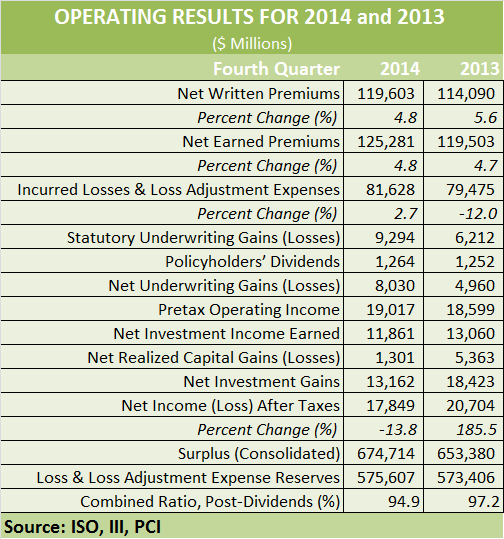
Looking back at 2014, Robert Gordon, PCI’s senior vice president for policy development and research, noted the contribution of good fourth-quarter numbers from underwriting activities. “Property/casualty insurers had another moderately good year in 2014, with fourth-quarter results particularly strong,” he said, referring to net written premium growth of 4.8 percent and a combined ratio that was more than five points better than breakeven.
At 94.9, the combined ratio was the lowest recorded in nearly three decades, according to the PCI/ISO report. The fourth-quarter combined ratio has averaged 106.5 since 1986, the report said.
2014Q4ISOPCI
Net premium growth outpaced the increase in net losses, which was only 2.7 percent in the quarter.
Still, net income fell to $17.8 billion in fourth-quarter 2014, down nearly 14 percent from $20.7 billion in fourth-quarter 2013.
Significant declines in net investment income–a 9.2 percent drop to 11.9 billion–and a $4.1 billion decline in net realized investment gains—drove overall net income lower in spite of better underwriting results.

Sources: ISO, PCI, III
http://www.carriermanagement.com/news/2015/05/26/140387.htm

Monday, January 6, 2014

Tague Alliance Members & Independent Agents Should Consider Embracing The E-Myth Concepts

If you are not yet familiar with the E-Myth and the concepts behind the business principles espoused by Michael Gerber it is time you become acquainted.  The fundamental tenant of the E-Myth is that a the "technician" or in our insurance world "producer" believes they have what it takes to run an agency and become an "entrepreneur" or "agency owner".  The myth is the producer believes he/she will have more time, more money, more control, more happiness, etc.  In order not to fall into the entrepreneurial myth, the business owner must be able to work "on the business" not just "in the business".

Take a look at a simple but solid concept called "Your Business Ecosystem"  and check out this snippet of content from E-Myth Revisited.

If you have not already read the E-Myth and want to get more insight into the concepts take a look at the E-Myth website at http://emyth.com/blog/

Years ago I read the E-Myth, then E-Myth Revisited, and finally E-Myth Mastery.  All of these books are great sources of information and you should consider them as part of your small business ownership education program.  Amazon sells all of the books.

It is critical that you think critically about building your business and making sure you are doing the things that will have a lasting positive impact on you and your families financial health long-term!

Thursday, September 26, 2013

Tague Alliance Brings The Agency Growth Seminar To Member Agents

Tague Alliance is always looking for ways to help our member agencies become more successful preferred independent agents!  We brought in the Agency Growth Seminar to train a number of our members in simple but effective ways to dramatically increase their revenue.  We had a great training session and look forward to seeing positive sales growth as a result of the immediately implementable ideas that were provided to the attendees.

The class size was limited to allow for good interaction and a more personal experience.


Talking shop!  The class took the agents through an agency analysis and then into solutions for growth.


How to maximize cross‐line selling by Taping the income potential of your book of business

Setting the Stage
“Most people already have the knowledge and ability to increase sales results.  What they don’t
have is the knowledge about how to put it all together, manage it and make it happen.”
Scott Channell

The Agency Growth System has four distinct features:

  • A Sales and Marketing System that generates a dependable and reliable source of new business.
  • Simplified Goal Setting
  • How to Tracking and Measure for Results
  • Staff Accountability


Problems and Challenges
Here is the reality of what you face on a daily basis: The average household owns 7.1 policies.
The average agency has a household penetration of 1.9 policies which means 5.2 policies are in some
other agency’s book of business. The numbers don’t get any better when you analyze life and
financial services. On average 1 in 12 households will purchase some form of life or financial
service from someone in the next 12 months. Over the next 7 years, statically, 100% of your book of
business will purchase life or a financial service from someone else.  It isn’t a question of “if”
they leave; it’s a question of “when.”

The problems and challenges that face insurance agencies never seem to change. Every agency has the same basic questions:

  • How can I increase New Business?
  • How can I improve Profits?
  • How can I improve Retention?
  • How can I accomplish all of this with the least amount of effort?


The Solution is Simple
Faced with limited resources and time, The Agency Growth System provides an agency with
ready‐to‐deploy field proven sales and marketing strategies where much of the work is already done
for you, not by you.


  • It is low impact for the staff and the client
  • It is specifically designed to redefine the agent’s role as a Profession Insurance Advisor
  • It focuses on what I believe is our Professional Obligation and that is to ask questions, identify problems and offer realistic solutions
  • It is a systematic and dependable way of producing a steady follow of new business.


The Agency Growth System Workshop

The participants will leave the workshop with a customized “Game Plan”, for their specific agency,
that can be immediately implemented and produce measurable results in days not weeks or months.

Implementation
The Agency Growth System takes the guesswork out of increasing sales and agency profitability by
giving the agency a unified approach to establishing an Agency Sales Culture based on simple easily
implemented strategies.

The sales strategies include:

  • Policy Review / Cross‐line Selling
  • Internet Sales
  • Targeted Markets
  • Life and Financial Services


Agency Growth Systems will provide implementation assistance and coaching for 30 days. We will do
what is necessary to make you successful.

The Philosophy
The philosophy behind the Agency Growth System is simple:    “Stop selling insurance!”

"I believe our Professional Obligation is to ask questions, identify problems and offer realistic
solutions. This means providing client with advice on all of their policies regardless of who
controls them. If we can accomplish this in a professional manner, clients will give you the opportunity to provide the policies they want."  Harlan Warthen

Monday, October 17, 2011

Breaking Down Equipment Breakdown!

Equipment Breakdown Protection

Equipment Breakdown coverage can be hard to understand! Tague Alliance wants to make sure you are able to present these types of coverages to your clients with confidence and knowledge. Read below to get the low down on the breakdown:

Many businesses use commercial property forms to insure their tangible assets. However, they also need Equipment Breakdown Protection Coverage due to some limitations found in those same forms. An Equipment Breakdown Coverage policy handles a substantial loss exposure to items such as unfired vessels - Air, steam or water tanks, refrigeration systems, rollers, steam pressers, ironing equipment, steam cookers, generators, chemical processing tanks, motors, switches and controls, compressors, pumps, gears, etc. because commercial property policies typically exclude losses involving machinery or equipment breakdowns. The breakdown form provides the following coverages:

1. Property Damage - This coverage pays for direct damage to covered property (certain types of office machinery and equipment) that has to be listed (described) in the policy.

2. Expediting Expenses - This coverage applies to extra costs insured experiences in order to make temporary repairs and to speed-up (expedites) the permanent repair or replacement of damaged property.

3. Business Income and Extra Expense – Extra Expense Only - These coverages may, optionally, be purchased together; or to buy extra expense coverage alone. For example, a covered business loses most of its records due to a breakdown of its main server. Most of the costs associated with restoring the information would be covered by the equipment breakdown policy.

4. Spoilage Damage - Spoilage damage to raw materials, property in process or finished products is covered when that property is either in storage or in the course of being manufactured, the insured owns or is legally liable under written contract for the spoiled property and a lack of or excess of power, light, heat, steam or refrigeration caused the spoilage.

5. Utility Interruption - This coverage is available ONLY when a customer also purchases coverage for Business Income and Extra Expense – Extra Expense Only or Spoilage Damage. This coverage responds to loss involving equipment breakdown created by loss of utility service (gas, electric, water or communication). Also, the loss or service must last beyond the time-limit that appears on the policy (a sort of time deductible).

6. Newly Acquired Premises - This feature automatically covers newly acquired premises purchased or leased by the insured and the period of protection depends upon the length of time selected for this coverage (i.e. such as 30 days, 60 days, etc.).

7. Ordinance or Law Coverage - The Ordinance or Law Exclusion eliminates coverage for loss created by the imposition of ordinance or laws affect the rebuilding of the damaged property. This coverage pays such costs, within guidelines in the coverage, provided any increase in the loss amount is necessary due to the enforcement of any laws or ordinances in force at the time of the breakdown which regulate the demolition, construction, repair or use of the building or structure.

8. Errors and Omissions - This coverage pays for loss or damage that would have been covered except for the insured’s error or unintentional omission in describing covered property, a failure to include any premises owned or occupied by an insured when coverage began or, the insured’s error or unintentional omission that results in the company canceling coverage at one of the insured's premises.

9. Brands and Labels - This provision pays part of a company's expense to remove and re-label its own, salvaged merchandise.

10. Contingent Business Income and Extra Expense – Extra Expense Only Coverage -. This Protection applies to loss resulting from a breakdown to equipment at premises upon which the insured is dependent upon in order to run its own operation, such as a key materials supplier.

Be sure to talk to the professionals at Tague Aliance in case you need details on how to best present this critical coverage to your commercial clients!

COPYRIGHT: Insurance Publishing Plus, Inc. 2006

Thursday, September 15, 2011

Insuring Your Bling

Your clients may not know that they can insure their jewelry on their homeowners policy. This is a great article to share with them so they are educated on their options when it comes to insuring their bling!

Most homeowners policies provide very limited coverage for jewelry. The reason for this is that jewelry is high-valued (especially in relation to its size), is easily lost or destroyed and is vulnerable to theft (as well as fraud). If you only own a modest amount of jewelry (say just a few hundred dollars), perhaps the limited coverage provided by a basic policy is adequate. However, when high values are involved, consider buying special insurance coverage (sometimes called a floater). A few options are available such as buying supplemental insurance that is attached to your homeowners or tenant's policy or purchasing a separate jewelry policy.

Discussing what is needed and expected from separate coverage is very important. Does the coverage consider jewelry values that increase over time? Does it cover mysterious disappearance (when you know the property is gone, but can't pinpoint when and how the property was lost) and other causes of loss, or just fire and theft? Discussing the coverage also helps you understand the steps you must take to make sure that you keep the maximum coverage in force and whether the coverage you receive is worth the additional price.

Documenting The Jewelry's Value
If the jewelry has just been purchased, a store receipt or certificate should establish the insured value. However, as time passes or circumstances change, the insured value must be reevaluated, perhaps by seeking an appraisal (expert opinion). Getting an appraisal that affirms your jewelry's current value is an excellent way to assure that your property is properly protected. Of course, make sure that you work with a competent appraiser (check their credentials and number of years of experience). It is also helpful to talk to a potential appraiser. Does she seem to have the necessary expertise? How willing and able is she to explain her work? There are several professional jewelry and appraisal associations that can give you information on appraisers and appraising methods. All of these items are important, especially since you have to pay a fee for an appraiser's services.

Handle With Care
Once you're certain about the value of your jewelry and the adequacy of its insurance coverage, you need to properly handle your jewelry. After all, who wants to actually file a claim? If you own a significant amount of expensive jewelry you may want to look into other precautions such as:
* Get new appraisals every two or three years, sending a copy to your insurer
* Take photos of your jewelry from several angles; again, share copies with your agent or insurance company
* Consider a quality in-home security system, including a hidden vault or storage area
* Take care on where and when your jewelry is worn to try to avoid becoming a theft target
* Keep original receipts and all appraisals, especially if they demonstrate that the jewelry's value is appreciating
* Ask your jeweler whether they have access to "Gemprint," or a similar jewelry identification system that documents a jewel's distinctive markings much in the manner of fingerprinting.
* Consider storing jewelry that is rarely worn in a bank or saving institution’s vault. (Note that such special storage often qualifies for an insurance premium discount)

Again, your first step is to talk to an insurance professional since he or she shares your concern that you have the protection you need at a price you can afford.

If you have additional info regarding scheduling your client's jewelry, Tague Alliance can help you answer any questions you may have. They can be reached at 760-729-1143, or you can visit them on the web at www.TAGUEALLIANCE.com

COPYRIGHT: Insurance Publishing Plus, Inc. 1999, 2002, 2008

Thursday, June 16, 2011

How Much Is That Doggie In The Lawsuit?

Here is a great article to share with your clients that have pets, or are considering getting a pet. It's very important to ask your clients if they have pets due to the additional exposure they create! If you have questions about the acceptability of certain dog breeds and/or dogs with bite history, contact your SIAA Master Agent, Tague Alliance for more information!

While dogs make great companions, playmates, and protectors, they also continue to be a problem for insurers. Nearly two million people are bitten by dogs each year with around 800,000 persons requiring professional medical treatment for their wounds. Each of these incidents is a potential lawsuit.

Have Teeth, Will Bite
Tens of millions of U.S. households own dogs and biting incidents keep climbing. A key factor that contributes to these incidents is the failure of dog owners to supervise and train their pets. Another problem is that many persons, especially children, do not know how to behave around dogs. Bites may occur when:

* a person stares at a dog, which the animal perceives as a threat or challenge
people attempt to handle dogs during sensitive moments (while a dog is trying to eat or while nursing puppies)

* trespassers or house guests invade a dog's territory

* "rough-housing" with a dog escalates beyond playing.

An Issue Of Control
Insurance is still designed to handle accidents, and companies are at a severe disadvantage when policies are asked to respond to losses that are easily avoided. Dog bite claims involve the insured having control over areas such as:

* choosing to own a dog

* choosing the particular breed of dog

* raising the dog in a certain manner

* housing the dog in a certain manner

* exposing the animal to various social situations

* being knowledgeable about a dog's temperament and inclination to bite or attack.

All of the above elements can contribute to lawsuits and to action from an insurer.

The "Policy" On Dogs
If you have homeowners insurance and you own a pet, the liability portion of your policy provides protection for losses arising from pet ownership. Not only are you and your household protected, but coverage even extends to persons who have custody of your pet. However, your policy won't cover businesses that may have custody of your pet, such as kennels, obedience schools, groomers and professional sitters or walking services (they should carry their own coverage). Further, coverage could become problematic if dogs in a home are related with unreported, in-home business activity. Losses involving persons who are bitten while in a home for business reasons may not be covered.

Minimizing The Problem
Owners have a responsibility to raise and handle their dogs in a manner that reduces the chance for a loss. Steps to take include becoming knowledgeable about their breed of dog and about general principles of ownership and care. They should make certain that family members, social visitors, neighbors and strangers are protected from the owner's pets. Owners should also take advantage of resources to help them, such as tips from animal shelters, dog ownership clubs, the AKC and a plethora of Internet sources.

It may not be the fairest set of circumstances, but more insurers are choosing not to give dogs the benefit of the doubt. It is becoming more common for companies to refuse to write coverage for persons who own certain breeds of dogs. Therefore, owners must fight this trend by not taking their pet ownership lightly....because insurers aren't.


COPYRIGHT: Insurance Publishing Plus, Inc. 1998, 2004, 2010

Tuesday, May 24, 2011

What's The Difference?! Vacant & Unoccupied Homes

First, there IS a difference. The difference between the two is a matter of time and intent. While unoccupancy is a temporary condition and an exception to a residence normally having occupants, vacancy generally represents abandonment of property. The point is that either condition may affect your coverage under a typical homeowner policy. It is quite important to understand the consequences of either condition in order to keep your coverage intact.

Peeking At A Homeowner Policy

Generally, a homeowner policy has a couple of areas that may be affected by a home's occupancy status: damage caused by freezing, or certain property and loss due to vandalism. Let's talk about them in detail.

A homeowner policy usually protects a home from any loss that is caused by a frozen:

plumbing system
heating system
air conditioning system or
appliance


Example 1: Fern Guddyson and her family leave their home in Minnesota in January. They'll spend the next 10 weeks in Miami because Fern is teaching a graduate course in Zen awareness at Palm Leaf University. During a bitter cold spell at their home at the end of March, the water line to their refrigerator (for its ice-maker) freezes and breaks. Later, when the line thaws, it overflows and, eventually, soaks all of the home's oak flooring and carpets. Fern makes a claim to her insurer when the family returns home. The insurance company rejects the claim when they find out the home was unoccupied for more than 30 days before the loss.

Unfortunately for the Guddysons, most homeowner policies will not cover freeze-related losses that occur during an extended period in which the home is either vacant OR unoccupied. But this loss of coverage can be avoided if the homeowner takes special steps. Precautions usually involve either draining any systems or appliances of water and shutting off the home's water supply, or keeping the home heated during the absence.

A homeowner policy typically offers protection to a home that is damaged by acts of vandals.

Example 2: Fern Guddyson and her family leave their home in Minnesota in January. Again, they'll be in Miami for the next 10 weeks while Fern gets her doctorate in surfing from Palm Leaf University. A week before the Guddysons return, a group of kids breaks most of their home’s windows. They then enter the home and use tools to smash doors, floors and walls. Fern makes a claim to her insurer when the family returns home from Miami. Their insurer estimates the damage and gives Fern a check to cover her loss.

Typically, vandalism losses are covered even during periods of extended unoccupancy. However, if the Guddysons had emptied their home of all furnishings and turned off the power for the time they were gone, the vandalism loss would not have been covered.

Why Are Such Exclusions Necessary?

Homeowner policies contain such exclusions in order to avoid special loss situations. A vacated home becomes an attractive nuisance, often attracting vandals. If a home is to be vacated, it may be necessary to purchase dwelling fire coverage to protect the home. In regards to loss caused by freezing, insurers want to encourage homeowners to do a little planning in order to reduce or eliminate the chance that a system or appliance causes a loss. If an insured refuses to act responsibly toward their property, they risk the chance of an uninsured loss.

If you're facing a situation in which your home will be unoccupied or vacant for an extended period, talk to the helpful people at Tague Alliance and make sure you do whatever is necessary to preserve your full insurance protection.

COPYRIGHT: Insurance Publishing Plus, Inc., 1996, 2000, 2007